Put Options Part 1
If you ever struggled to remember what "Selling a Put Option" means, don't worry, you are not alone.
The key concept of an option is easy to understand.
True to its dictionary meaning, it literally means you have an option to do something, and not an obligation.
Its usage in the context of the stock market is also relatively easy to understand.
When you own a stock option, you have the option to buy shares of a company, but you have no obligations to do so.
It starts to get a tiny bit confusing when you find out that there are two types of options. The option that you intuitively understand is the first type, a call option. And the second type, a put option, gives you the right to sell shares of a company at a certain price.
I think it personally starts to get a little trippy when I start to explain to others that you can buy and also sell a call option or put option.
Even though I have learnt these concepts since my university days, I still find it a mouthful when I have to explain the 4 different positions to others.
So here’s my small attempt to present it in a way that is clear and easy to remember.
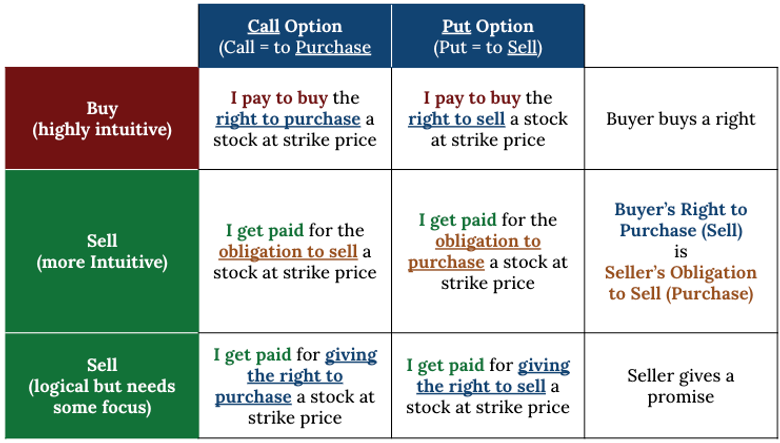
The 4 x 4 table shows the 4 option positions.
The blue colour reflects the intuitive buyer positions of buying a Call Option and Put Option. The red colour reflects at expense, an outflow of cash, to purchase a right. And the orange colour reflects the less intuitive opposing seller position positions of selling a Call Option and Put Option as reflected in the obligation, but you earn an option fee, which is reflected in the green colour, which symbolises a fee earned, an inflow of cash.
And a bonus tip for those who struggle to recall (referring to myself actually), which option gives you what right.
Buying a Call Option gives you the right to buy a stock. You can imagine calling the waiter over to buy a drink, but in this case, to help you buy a stock.
Buying a Put Option gives you the right to sell a stock. You can think of it as a right to put it in someone's pocket or portfolio.
It is helpful to remember the buyer's positions first, and than the seller's position is the other side. It can still be a little trickier, because our brain is used to thinking from buyer pov and less of a seller pov. The key insight for me that unlocks the seller's pov, is the realisation that whenever you sell something, you have an obligation to deliver the goods. If you sell a t-shirt, you receive money, and you have the obligation to give the buyer the t-shirt.
So remember that selling, gives you an obligation.
Therefore, when you sell a Call Option, you give the buyer the right to buy the stock, and you have an obligation to sell the stock.
And when you sell a Put Option, you give the buyer the right to sell you the stock, and you have an obligation to buy the stock.
And that's pretty much it.
Now, I feel like I have the right mental models to remember and explain the 4 positions to others, and I hope that it will help you as well.
On a personal side note, I find the concept of selling a right and taking on an obligation as a pretty cool abstract type of service. It is like running a type of business where you don't sell physical products, but a right to others in exchange for a fee. It becomes even more interesting when you can earn this fee for 'free', because you get paid to take on an obligation to do something, that you already intended to do.
On my next note, I will share about how this hybrid investment / income generation strategy of selling covered Call and Put Options can be used to generate a nice monthly investment income.
Subscribe and stay tuned :)